Substance updates apply as necessary
OSHA HazCom 2024: Florida Substance Updates Due November 20, 2026
OSHA says it "does not anticipate that most employers will need to complete" extra in-house label, written program or training updates following its 2024 changes to hazard classification. Employers covered by HazCom must make those updates "as necessary" for newly identified hazards involving substances by November 20, 2026.
For a restaurant or hotel, the check starts with the supplier's revised safety data sheets (SDSs): do they identify a hazard the site's labels, written hazard communication program or training haven't covered? Mixtures have a separate employer deadline, May 19, 2028.
Federal OSHA covers most private-sector workers in Florida, where there is no OSHA-approved state plan. It excludes state and local government workers, so a pool team employed by a city falls outside that coverage.
Does November 20 require another training session?
OSHA's inspection directive for HCS 2024 took effect on May 19, 2026. The directive ties updated training to the hazard employees haven't learned about. Its example uses solvents: a second flammable solvent needs no updated training where staff already know that hazard; introducing a corrosive requires training on the new hazard.
When a revised SDS arrives, the housekeeping manager checks for hazards missing from existing training. A new revision date alone doesn't require another session.
The directive requires training at no cost to employees, on paid time, in a language and at a literacy level they understand. Handing out SDSs alone doesn't count as training.
A dated check against the SDS file
The HazCom standard allows employers to rely on the manufacturer's or importer's classification. An operator can ask the supplier whether a product is a substance or mixture rather than classify it independently. The standard defines a mixture as two or more substances combined without reacting.
An SDS puts hazard identification in Section 2 and its preparation or last revision date in Section 16. Those fields let a manager compare the supplier's current information with the site's existing program. A dated review file can hold:
- The SDS inventory. Each product identifier and SDS revision date, with the supplier's confirmation that the product is a substance or mixture.
- The comparison note. The reviewer, review date, hazards checked against existing training and labels, and any change still to finish. A review that finds no newly identified hazard can record that result.
- The label check. Which spray bottles or dispensers needed changes, with dated photos of the revised labels.
- The written program. The reviewed version and date, beside its chemical list and arrangements for labels, SDS access and training.
- Training evidence where an update was needed. The date, hazard covered, language used and employees who attended.
The standard requires the written program, the hazardous-chemical list and the SDSs themselves. Paragraph (h) prescribes no training record, so the review note, photos and training sheet serve as supporting evidence. SDSs must remain readily accessible to staff during each shift, and electronic access must leave no barrier to immediate employee access.
In a hypothetical hotel, a housekeeping product's name and familiar packaging don't decide which deadline applies, so the manager asks the supplier. The supplier confirms that the product is a substance, and its revised SDS adds a hazard staff haven't covered. The manager checks in-house labels, updates the program where needed and trains staff on the new hazard. The review note records the changes, completion dates and employees trained.
OSHA's directive requires in-house label updates by the relevant employer deadline when the supplier's classification changes. An in-house label needn't carry a pictogram. Under the alternative-label option, it must identify the product and give general hazard information; that label and other immediately available information must together explain the chemical's specific physical and health hazards.
Duty Room keeps each site's HazCom program, SDS inventory and training records organized and dated. The operator and adviser decide which hazards need action.
Retail cleaners and pool disinfectants
The consumer product exemption depends on use. The employer must show that staff use the product for its intended purpose, with exposure no greater in frequency or duration than consumers could reasonably experience. OSHA's consumer product interpretation distinguishes occasional cleaning of an employee's own workstation from routine exposure during normal duties. The directive expressly includes custodial work such as cleaning bathrooms.
EPA lists pool disinfectants and food-contact sanitizers among antimicrobial pesticides. For a hazardous product subject to EPA pesticide labeling, the EPA label takes precedence over OSHA's label requirements. SDS and worker-training duties generally remain; OSHA identifies exceptions for certified applicators and agricultural workers covered by EPA training requirements. OSHA's directive says an in-house secondary container used for decanting or dilution can require workplace labeling where no other preemption applies. So a hotel pool team checks the diluted product's container as well as its SDS and training.
The mixture deadline and ongoing training
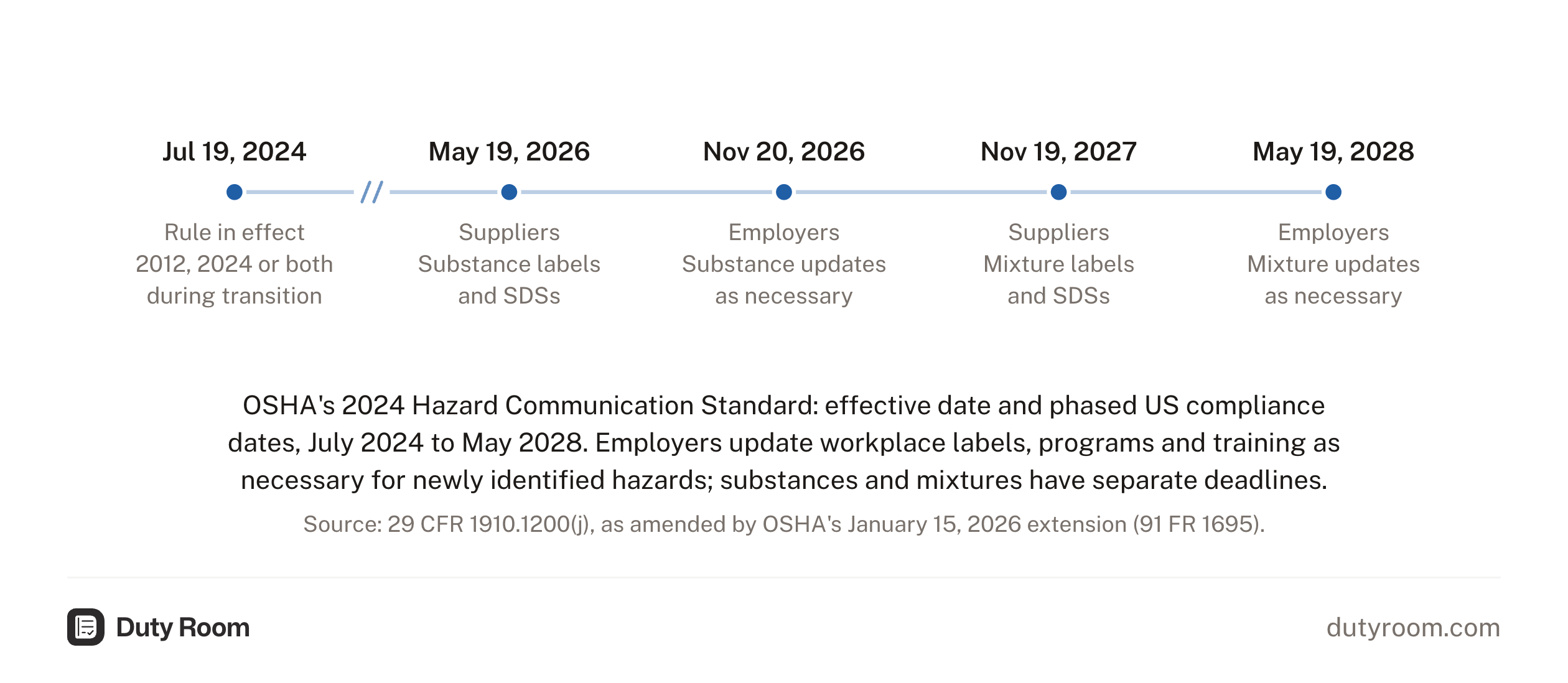
OSHA's January 15, 2026 extension moved the deadline for employers using substances from July 20 to November 20, 2026. In the timeline below, each supplier deadline comes before the matching employer deadline.
| Calendar date | Who | Requirement |
|---|---|---|
| July 19, 2024 | Manufacturers, importers, distributors and employers | Rule in effect; 2012 standard, 2024 standard or both permitted until the relevant compliance date |
| May 19, 2026 | Manufacturers, importers and distributors evaluating substances | Comply with modified provisions, including substance labels and safety data sheets |
| November 20, 2026 | Employers using substances | Update alternative workplace labels, hazard communication program and training as necessary for newly identified hazards |
| November 19, 2027 | Manufacturers, importers and distributors evaluating mixtures | Comply with modified provisions, including mixture labels and safety data sheets |
| May 19, 2028 | Employers using mixtures | Update alternative workplace labels, hazard communication program and training as necessary for newly identified hazards |
The May 19, 2028 mixture date applies to necessary updates arising from the 2024 revisions. The training rule still requires effective training at initial assignment and whenever a chemical hazard employees haven't previously learned about enters their work area.
This briefing is based on sources available at publication and is for general information only. It doesn't constitute legal advice. For advice on your specific situation, consult a qualified professional.
Keep each site's HazCom review dated
Duty Room keeps your SDS inventory, label reviews and training records organized and dated by site.