12 November and 11 December 2026
Federal Hemp Ban: Two Deadlines for Florida Bars and Restaurants
Pull a hemp THC seltzer from your back cooler. If the label says 2, 5 or 10 milligrams of THC, the can sits well above the new federal 0.4 milligram cap. That cap now applies from 11 December 2026, after Congress delayed most of the hemp redefinition. A product above it no longer qualifies as hemp.
12 November still matters for a narrower group: products containing cannabinoids that the cannabis plant cannot naturally produce. That is different from a naturally occurring cannabinoid manufactured outside the plant. The latter exclusion, like the per-container cap, now applies from 11 December.
The change comes from Section 781 of Public Law 119-37, signed 12 November 2025. Congress split its original November deadline through Section 2019 of Public Law 119-103, signed 2 September 2026. The extra month changes which stock needs to leave first; it does not remove the cap or the exclusions.
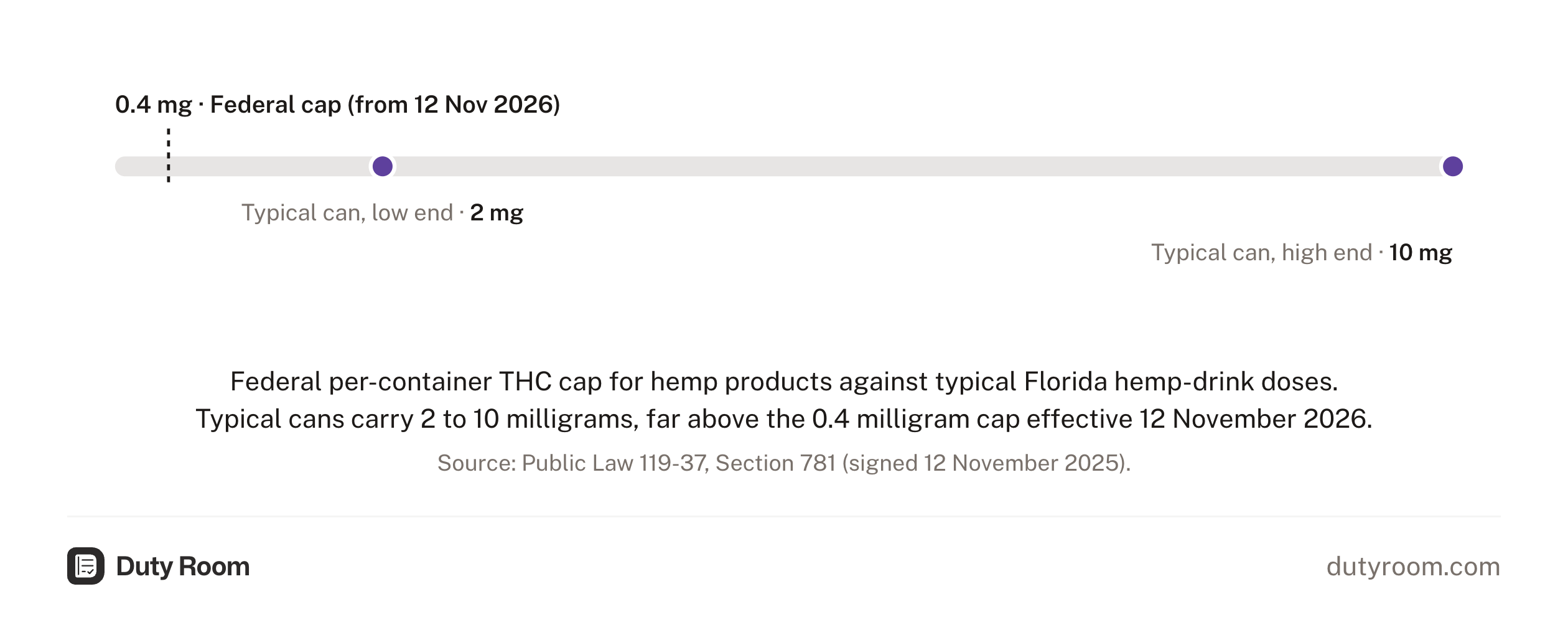
| Reference point | THC per container (mg) |
|---|---|
| Federal cap (11 Dec 2026) | 0.4 |
| Example: 2 mg can | 2 |
| Example: 10 mg can | 10 |
Inside the 0.4 mg cap
The federal cap is per innermost retail container, not per serving. A can, bottle, gummy bag, or vape cartridge counts as one container, and the 0.4 mg ceiling applies to the whole thing. Once the definition changes, a product above the cap no longer qualifies as hemp. The Controlled Substances Act treats cannabis material outside the hemp definition as marijuana unless another exemption applies.
The cap measures total THC, not delta-9 alone. Tetrahydrocannabinolic acid (THCA) and delta-8 THC count too. The same 0.4 milligram ceiling also includes other cannabinoids with similar effects—or marketed as having similar effects—as determined by the Secretary of Health and Human Services. FDA was required to publish cannabinoid lists and further container guidance within 90 days of enactment; the Congressional Research Service's 28 September 2026 update records them as still unpublished.
Dose is only one test. Products containing a cannabinoid that cannot occur naturally are excluded from 12 November regardless of the amount. From 11 December, the definition also excludes products containing naturally possible cannabinoids synthesized or manufactured outside the plant. A supplier's "hemp-derived" label does not settle that distinction. Section 781 is silent on sell-through, recall, or distributor takeback.
Why this is a Florida license issue
Florida's hemp law sets a 0.3 percent total delta-9 THC limit. The basis is dry weight for the plant, and wet weight for hemp extract sold to eat or drink. FDACS enforces this rule and removed more than 85,000 hemp packages from 40 counties during Operation Safe Summer by the July 2025 update.
The federal cap is a different test. It measures total THC per container instead of THC percentage by weight, so a product can pass the Florida wet-weight test and still fail the federal per-container test.
FDA food and supplement rules are a separate question. A product within the federal hemp cap is not automatically lawful as food. The FDA's CBD position is that CBD cannot be added to food or labeled as a supplement.
Your DBPR DABT exposure comes through the alcohol license, not a new hemp license. Florida law lets the division suspend or revoke a Beverage Law license for state or federal law violations by the licensee or its staff on the licensed premises, or elsewhere within the scope of employment. It also covers permitting another person to violate the law on the licensed premises. That is the licensing risk to plan for; the statute does not prescribe a hemp-specific enforcement timetable.
Alcoholic Beverages and Tobacco handles licensed-premises investigations. DBPR's 2025 accomplishments report, published 7 January 2026, records more than 2,798 hemp-product compliance checks and 141 underage-sale violations by ABT. FDACS regulates hemp extract under Rule 5K-4.034. The cited DBPR report describes underage-sale enforcement; it does not set out how the division will apply the federal redefinition.
The two Florida bills discussed here did not create a new state pathway. HB 801, which would have given DBPR DABT licensing authority over THC-infused beverages, died in the Industries & Professional Activities Subcommittee on 13 March 2026. HB 1409, a broader THC and hemp-extract bill, died in the same subcommittee the same day.
The pre-deadline operator sequence
The transition splits across four functions, each with a different vendor relationship and internal owner. Record the applicable November or December deadline beside each SKU:
SKU audit. Pull every hemp THC product on your trading list. For finished retail products, check the combined total per innermost container and whether any cannabinoid falls into either exclusion. A low dose does not rescue an excluded cannabinoid. Ask for the current certificate of analysis (COA) and production information: the COA can show the dose, but does not necessarily establish how the cannabinoid was made. A THC ingredient supplied for mixing also needs an intermediate-product check; applying the finished-can cap alone would miss that category.
Distributor conversation. Ask whether the distributor will offer takeback for credit, replacement, or no return, and by what date. The answer may vary by brand, contract, and inventory exposure. What you want on file is the written answer tied to each SKU.
POS and menu update. POS and menu work is where old inventory decisions keep showing up. A pricing system that still sells an excluded SKU after its deadline creates a sale record for a product that no longer qualifies as hemp. A printed menu that lists the SKU keeps advertising it. POS code retirement, menu reprint, and online-ordering edits each run on their own cycle.
Cocktail-program review. THC mocktails and low-ABV cocktails need their own pass. If the base ingredient is federally non-compliant, the recipe loses its base when the SKU goes. Recipes built on a specific 5 mg or 10 mg ingredient need a substitute or a removal before the applicable deadline.
What could still change
The two standalone delay bills from Rep. Baird (R-IN), H.R. 7010 and the Hemp Planting Predictability Act (H.R. 7024), remain in the House Agriculture Subcommittee on Forestry and Horticulture, with no action after 20 May in GovInfo records checked on 7 October 2026. A proposal is not a further extension: keep the enacted dates in the stock plan unless the law changes again.
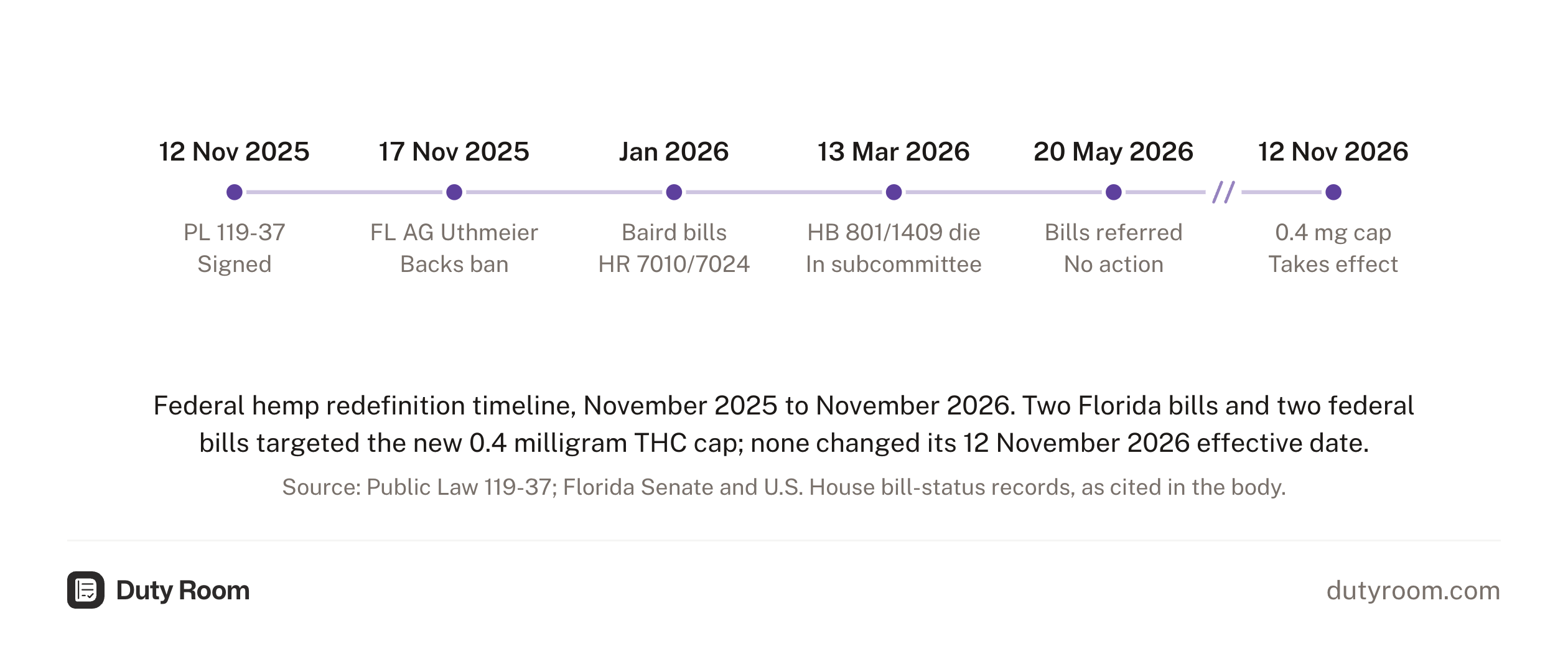
| Date | Event |
|---|---|
| 12 Nov 2025 | Public Law 119-37 signed |
| 2 Sep 2026 | Public Law 119-103 signed, delaying part of the redefinition |
| 12 Nov 2026 | Exclusion for intermediate and final products containing cannabinoids not capable of being naturally produced by the cannabis plant |
| 11 Dec 2026 | Remaining changes, including the 0.4 mg cap and exclusion for naturally possible cannabinoids synthesized or manufactured outside the plant |
Florida could legislate further on hemp or carve out a state pathway, but the 2026 session has ended, and no state law can rescue a federally non-compliant SKU from CSA treatment.
Keep the decisions with the premises records
Duty Room for Florida liquor compliance brings together license conditions, to-go cocktail records, and the three-year purchase log in one per-site view. The hemp transition belongs beside those records: dated SKU decisions, distributor answers, and removal notes against the same licensed premises.
This briefing is based on sources available at publication and is for general information only. It doesn't constitute legal advice. For advice on your specific situation, consult a qualified professional.
The records your liquor licence depends on, per site
Keep Florida Responsible Vendor training, refusal logs, and purchase records current, with evidence organized across sites for owners and DBPR's ABT.