One Bad Night Cascades
Ontario's Overservice Crisis: Three Deaths, Three Suspensions
Three Ontario venues faced public AGCO action after overservice deaths. The cases differ in detail. The enforcement pattern doesn't: long overservice runs, a fatal outcome, then a suspension before the civil claims and prosecution files even begin to take shape.
At Mister Wolf in Toronto, a 19-year-old was served three large bottles of liquor in a VIP area in May 2024, left the premises, and was found dead the next day. His blood alcohol concentration exceeded twice the legal driving limit. The AGCO moved against the licence in January 2025, and Toronto police laid charges against the owner under Ontario's liquor laws.
At My Friends Place in Woodstock, a patron was served 17 beers in four hours on October 6, 2024, fell outside, struck his head, and later died. Less than three weeks later, the AGCO says another patron at the same bar was over-served and allowed to drive away. The AGCO moved against the licence in April 2025.
At a Boston Pizza in St. Catharines, patrons were over-served in December 2023, drove, and caused a fatal car crash. The AGCO moved against the licence in October 2024.
The enforcement response
In each case, the AGCO moved first with a proposed 60-day suspension, before the civil claims and prosecution files had finished taking shape. For a bar or restaurant, where drinks commonly run around a third of revenue, two months without serving alcohol means operating at half capacity or closing entirely.
A suspension is only the first visible consequence. Revocation remains on the table. The AGCO's enforcement options include permanent revocation, and the regulator has used it. In 2024, Hamilton's Club 33 received an immediate suspension and Notice of Proposal to revoke after repeated violent incidents, including a shooting that wounded three people. In 2025, INXX Lounge in North York received a Notice of Proposal to revoke after repeatedly blocking AGCO inspectors from entering.
Of 52 AGCO decision summary cases compiled from 2017 to 2021, 12 (23%) resulted in permanent licence revocation. Our AGCO inspection violation briefing covers the routine inspection side of the same enforcement system. When the AGCO escalates to revocation, the licence is gone.
Civil liability adds millions
Beyond AGCO penalties, Ontario's commercial host liability doctrine creates a separate financial exposure. Section 52 of the Liquor Licence and Control Act, 2019 allows injured parties to sue the seller of liquor for damages caused by an intoxicated person. In the leading Ontario case, Hague v. Billings, the Court of Appeal held the bar 15% liable for a fatal crash caused by a patron it had over-served. A share that size still runs to real money when the damages are large.
A civil lawsuit in Barrie, Ontario, claimed $11.2 million after a bar over-served a patron who then caused a serious car accident. The claim names the driver, the owner of the vehicle, and the bar. Whether it settles for the full amount is secondary. The legal cost of defending an $11.2 million claim, the insurance implications, and the reputational damage operate independently of whether the AGCO also suspends the licence.
An overservice death doesn't stop with the AGCO. In these three cases, the suspension notices came 186 to 297 days after the fatal incidents: about six months for My Friends Place, eight months for Mister Wolf, and ten months for Boston Pizza. Civil claims, prosecutions where police lay charges, and possible inquest scrutiny follow on their own timelines, sometimes over years.
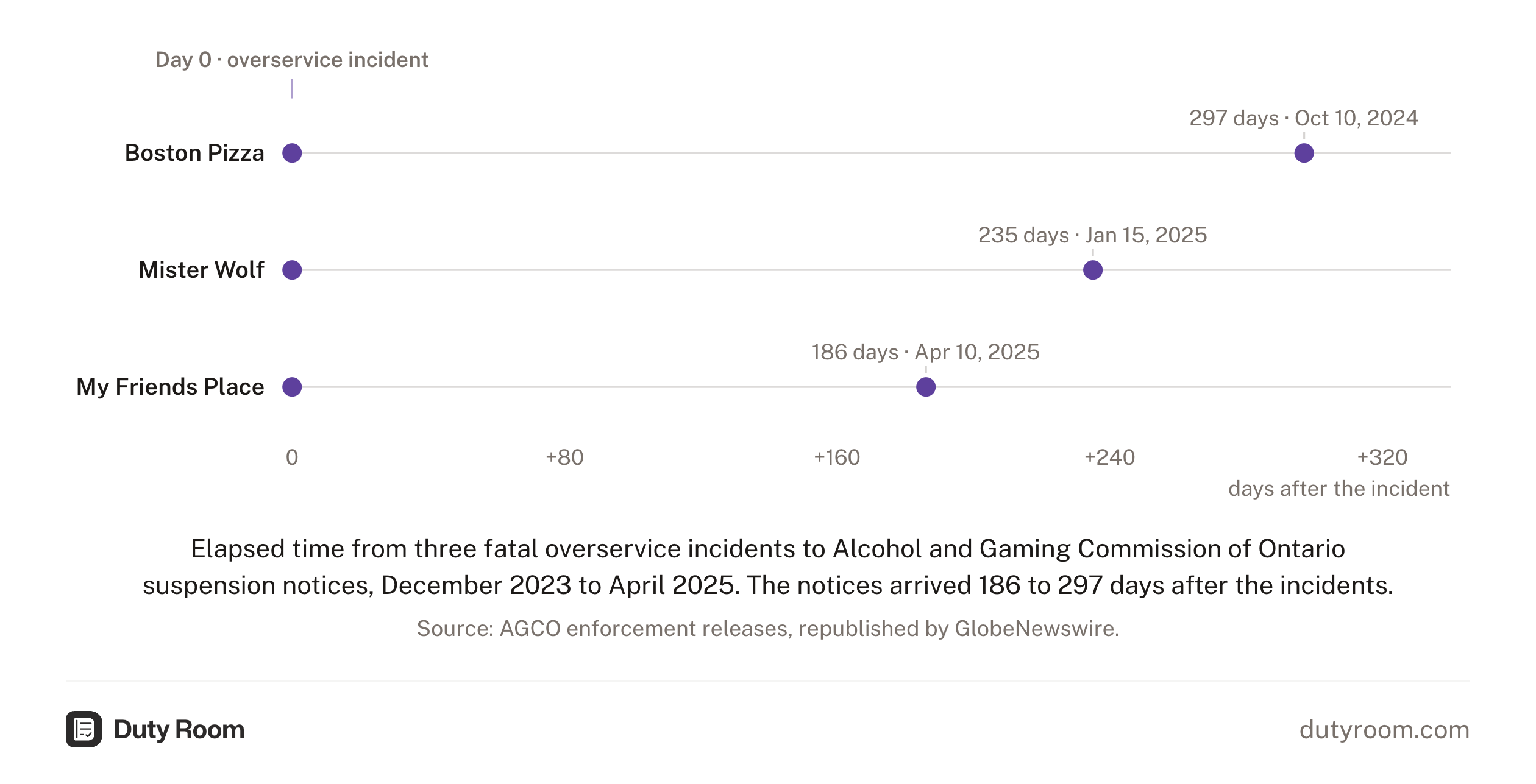
| Venue | Overservice incident | AGCO suspension notice | Elapsed time |
|---|---|---|---|
| Boston Pizza · St. Catharines | December 18 2023 | October 10 2024 | 297 days |
| Mister Wolf · Toronto | May 25 2024 | January 15 2025 | 235 days |
| My Friends Place · Woodstock | October 6 2024 | April 10 2025 | 186 days |
AGCO guidance already warns about this chain
The AGCO has been warning licensees for years that overservice can trigger licence action, criminal charges, and civil claims at the same time. These deaths didn't create a new rule. They're the kind of case the AGCO has long said would trigger suspension, civil exposure, and possible revocation.
The pattern in the three 2024-2025 cases is the same: a patron consumed a quantity of alcohol that should have triggered a refusal of service long before the final drink. In the My Friends Place case, 17 beers in four hours is more than four beers per hour. In the Mister Wolf case, three large bottles of liquor for a single patron in a VIP area. None of these were borderline service decisions; they were failures any trained server should have caught, and that any Smart Serve-certified staff member is specifically trained to prevent.
The pattern across the three cases
The three deaths in 18 months are connected by the same failure: staff served alcohol well past the point of intoxication, and service was not stopped. Smart Serve certification covers the legal rules for recognizing and refusing intoxicated patrons. In two of the three cases, the AGCO's allegations include staff who lacked the required Smart Serve training. In all three, service continued long past the point where a trained server should have stopped it.
In the My Friends Place case, one guest reached 17 beers in four hours. A bar where that can happen has failed long before the inspector arrives. Our Ontario liquor compliance resources cover the records behind refusals, incident logs, and staff training.
This briefing is based on sources available at publication and is for general information only. It doesn't constitute legal advice. For advice on your specific situation, consult a qualified professional.
The AGCO doesn't call ahead. Be ready anyway.
The AGCO cited 12,337 violations in a single year. Duty Room keeps Smart Serve expiry dates, refusal logs, and licence conditions current per site.